Showing posts with label Katrina. Show all posts

Tuesday, August 21, 2007

Changes

West Point Lighthouse *** PEI

*****

Sometimes when I have nothing to say, I look back at previous years' posts.

Today, if it were today in any of the past six years, I would be back for the teachers' orientation week at the Orthodox Jewish school in which I taught Social Studies. I would be wearing a long skirt, lugging AP textbooks from storage to classroom, and gossiping with colleagues.

Instead, I continued my efforts to purge our house of its twenty-three years of accumulated junk which includes, among other things, the English papers of a long-ago college student. As I looked at reams of typo-filled onionskin pages and the stream of comments that cover so many of them, I felt intense gratitude for the rigor of professors who were unencumbered by either grade inflation or a sense of duty toward the "self-esteem" of their students.

On the positive side, a freshman year paper on Richard II, with a B+(+) at the end and a lengthy comment beginning with the words, "A very good piece of work -- well-written, well-documented. (It is very refreshing to come upon a paper that actually shows some control of style.)"

More typical for some classes, a paper on William Blake for a junior year honors class, graded C+/B- with comments beginning as follows: "You must sharpen your language and avoid rhetorical evasions and redundancies."

I have decided to evade further paper sorting and look redundantly at photographs instead. Two years ago the Lovely Daughter and I had just returned from a graduation trip to Prince Edward Island, Katrina was in no one's lexicon, and college in Oregon instead of in NOLA was in no one's line of vision. How quickly things changed in a week!

Friday, July 27, 2007

Chicago Calls

Sunday's my birthday!

And we're spending the week-end in Chicago with ALL of our children!

Life is very good right at this moment.

**********

And....it's the Friday Five:

1. Have you experienced living through an extreme weather event- what was it and how did you cope?

Well, there was Katrina . . . I was the one at home while everyone else was stranded in Baton Rouge after unloading The Lovely Daughter's stuff at Tulane; I was the one yelling into the phone, "I know you can't see the weather channel, but I CAN!!! And it is very very very VERY big!"

2. How important is it that we wake up to issues such as global warming?

Pretty much.

3. The Christian message needs to include stewardship of the earths resources agree/ disagree?

100% agree.

And because it is summer- on a brighter note....

4. What is your favourite season and why?

October is my favorite season. There is nothing at all like October in Williamstown, Massachusetts. Or October anywhere else.

5. Describe your perfect vacation weather....

Crisp, clear, 65 F at night and 85 F during the day. The weather is not complete, of course, without the ocean.
But Lake Michigan will do!

Friday, December 29, 2006

What We Don't Know

The Polar Bear has written a great entry on the topic of our tendency to believe that we understand each other when, in fact, we don't "really know." We think that our own limited experience, leavened with a hefty dose of uninformed opinion, endows us with authority on the lives of others. Polar Bear's plethora of examples caused me to think of a few of my own:

Too young for love? I fell head over heels in love for the first time at the ripe old age of eleven, with the result that my innocent adoration of the smartest boy in the class was dismissed as puppy love. Really dismissed, as I discovered a couple of years ago when I stopped by to see him and my father stared at me blankly when I said, "You don't remember how crazy I was about him? You don't remember how, in that pre-feminist era, I dreamed of becoming Mrs. Adams?" (Morticia, to be exact.)

I went to visit the man in question because I ran into his younger sister and learned where he is. He has been massively disabled by disease and spends his days staring at the television in the nursing home bed to which he is confined. Nevertheless, the wit and intelligence I remember from sixth grade are still lodged in his head as is, I found to my surprise, his memory of me -- the little girl whom an 11-year-old boy could never have admitted to "liking."

That first kiss, engineered over Spin-the-Bottle (which, as we all know, "doesn't count") was long ago, but the feelings were strong enough that I haven't forgotten them.

*****

Too old for grief? My father has been widowed three times and divorced once. After his wife died two years ago, he told me that in some ways it was harder than it had been when he was 28 and lost a child as well, or when he was 38 and lost a wife for the second time in a decade. "At those times," he said, "I had young children to think of, and work to hang onto. Now. . .what?" He has filled his life with his interests and the companionship of friends, but he is not too old to feel the devastation of an empty home in which conversation and laughter once reigned.

*****

Too stubborn for reality? A few nights ago when visiting extended family, we were treated to my brother-in-law's and 14-year-old niece's views on the idiocy of rebuiding New Orleans. "How stupid can people be?" asked the young lady. "They can do whatever they want, but don't ask me to insure it with my tax dollars!" exclaimed her father.

My mild references to NOLA as a significant port city, critical to our economy, and to the fact that it is HOME for thousands of people, made no impression. But then my own 19-year-old daughter began to talk, and her uncle and cousin fell silent.

"When I was volunteering there last spring," she said, "we were working on one house and a guy came around and asked us to talk to a lady at another house. So we walked a couple of blocks and there she was, with all her stuff piled outside, insisting that she wanted to keep it all. 'Ma'am,' we said, as gently as we could, 'you can't keep it. It's all mildewed and ruined and it will make you sick. We really have to take it away.' And she sat there and watched, staring at us, as we put all her wordly possessions into bags to be carted away. She was LIVING ON HER PORCH."

(That would have been six or eight months or so after Katrina.)

*****

No, we don't know.

Friday, August 25, 2006

One Year Ago

A year ago my youngest was en route to her college orientation with her father and brothers, while I was doing exactly what I've been doing this week, participating in my own school's teacher orientation week.

Who could have imagined
what was coming?

Saturday, May 06, 2006

Katrina'd

When the lovely daughter headed off to college last fall, it was with the same anticipation and eagerness that most freshmen feel. A new part of the country. A dorm, a roommate, classmates from everywhere. Classes in subjects always just out of reach in high school -- psychology, philosophy, Italian. A new beginning.

I couldn't go. As a teacher, I had to begin my work year at the same time that she did. So I stayed home and commiserated with a friend in the same boat, while our husbands accompanied our daughters thousands of miles from home. For my husband and sons, who would not go back to college for a few more weeks, it was supposed to be a nice little family vacation. There was a lot of laughing just before they left over the fact that the boys would turn 21 just after they left the French Quarter and Bourbon Street -- but at least they would get to see what they would be missing.

Well, we all know
what happened.

After leaving most of her clothing and belongings in her dorm room and spending three days in Baton Rouge and two more back on the road, the lovely daughter turned to me and said,

"Mom, I did everything I was supposed to do. I worked hard and got good grades. I did the SATs and ACTS and APs. I visited colleges and did interviews and wrote essays. I filled out an endless series of forms. I got my letters and I made my choice and I went shopping and we drove 1000 miles, and my college...DISAPPEARED. What do you do when your college just disappears?"

Now there's a question to which I had always wanted to know the answer.

At first she thought she'd just stay home and take classes at a nearby university for the semester. "That was pretty traumatic," she admitted -- an attitude she retained for about an afternoon. By the end of the day she had remembered: "I never wanted to go to college in-state. I don't want to go to college in-state now. Do you think I should call all the colleges to which I was admitted?" And by the next afternoon she was settled: Willamette in Oregon would be her next stop, with a full tuition waiver as Willamette's contribution to the hurricane relief effort.

(I used to think it was a little strange that kids sent applications to such disparate kinds of colleges. That was until I accompanied one of my sons to an Admitted Students Week-end, where it seemed that everyone we met, including my own indecisive offspring, was wranging over the choice between Big Bad City University of Chicago and tiny, bucolic Northfield, Minnesota's Carleton College. Just like the rest of us, teenagers are struggling with the who-am-I-and-where-do-I-want-to-be-in-life question. So when my daughter's final two choices emerged as boistrous and wild Tulane and New Orleans and tiny and somewhat more placid Willamette and Salem, Oregon, I was prepared to go with the flow.)

I can't say enough good things about Willamette University. The lovely daughter arrived after freshmen orientation was over and classes had begun to a delightful roommate, a complete set of bedding, a welcome basket from food services, and a welcome letter from the president of the college. Her advisor got her into courses the next morning, the bookstore could not have been m0re helpful, and she was on her way. Over the course of the next three months she made a great group of friends, did a terrific job academically, played intramural soccer, volunteered at the Salem animal shelter, watched Gray's Anatomy on Sunday nights, and just generally had the best first semester of college that any of my three children have experienced.

In January: Back to Tulane. This time it was a little more difficult -- she had already built a college life elsewhere. The roommate with whom she had corresponded back in August had never shown up then, and decided not to return for the second semester. Katrina permeated the atmosphere, the news, the consciousness of everyone at every level. In its wake was a beginning of a semester was full of the triumphant sense of survival and the energy of renewal.

The girl dove in -- studying conscientiously, making friends, singing in the college choir, volunteering in the 9th Ward, dating a little, and finding a new Gray's Anatomy group. But it wasn't the same -- she had left her heart behind at Willamette. And there wasn't anyone to talk with about that. Most of her classmates, who had spent their first semesters in college situations they disliked, were thrilled to find themselves finally beginning their long awaited first semester at Tulane. And the size of the school was a bit daunting in and of itself -- she found that she often met people whom she liked, and then never laid eyes on them again. At Willamette, her natural reticence had been thwarted by the tiny campus, where she couldn't help but run into everyone she knew every day.

I watch each of my children struggle with the choices of young adulthood, and I try to stay out of it. (Really, guys, I do! You have no idea how MUCH I leave unsaid!) I worked hard to keep myself out of this one. Not that I knew what the answer was. Of course, I had some views, which I restrained myself from announcing. The Willamette admission counselor was a candid and forthright woman who easily acknowledged the difficulty of the circumstances: the allegiance to an original dream, the sense that there might be more opportunites at a larger school, the feeling of responsibility toward the renewal of New Orleans, the brevity of the experience there, all balanced against the equally brief but undeniably satisfying experience at Willamette. The Tulane advisor, in contrast, did not respond to an email that should have alerted her to the fact that a major decision was in the works.

My comment, when asked point blank what I thought: You succeed in life when you are surrounded and supported by people who care about you and whom you care about. It doesn't matter how large or small, how prestigious or unknown, how near or far, the institution or locale. What matters is whether you can make a place for yourself and find "your people" there. We will love you and support you no matter where you decide that is.

A visit back to Oregon over Easter week-end clinched the deal. Within a matter of days my daughter had a roommate, a room, and a schedule of classes for next fall at Willamette. She sounded happier and more settled than she had in weeks.

I can hardly wait to see her tonight. She sounds so adult, so at peace with herself, on the telephone. I think that she has had a profound experience of finding out who she is, what matters to her, and how she can live most happily and productively. Not a bad beginning for 18.

Wednesday, April 12, 2006

New Orleans, New Orleans


I had sort of imagined her going to college among the ivy-covered Georgian and federalist buildings of New England ~

**********

Sunday, January 29, 2006

The Blues


A little blue heron is a fragile bird. Even though it's about two feet high and its wingspan exceeds three feet, its leg and wing bones are so long and spindly that it seems spectrally susceptible to any gust of wind. That long curved heron neck doesn't appear to add anything in terms of solidity.

And yet there they were, survivors of Katrina, mucking about in the canal as if nothing had ever happened.

I spent part of an afternoon during my New Orleans trip at the Barataria Preserve of the
Jean Lafitte National Historical Park and Preserve. Monsieur LaFitte was a pirate of some renown, remembered by name in the form of a tiny town and the various components of the Preserve that lie scattered across the Mississippi Delta. I don't know what kinds of natural blasts from water and wind he endured, but as a pirate he's as good a symbol as any for survival in the face of the merciless ravages of weather and politicians.

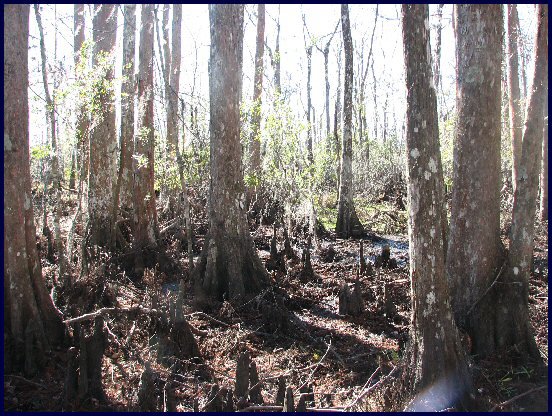
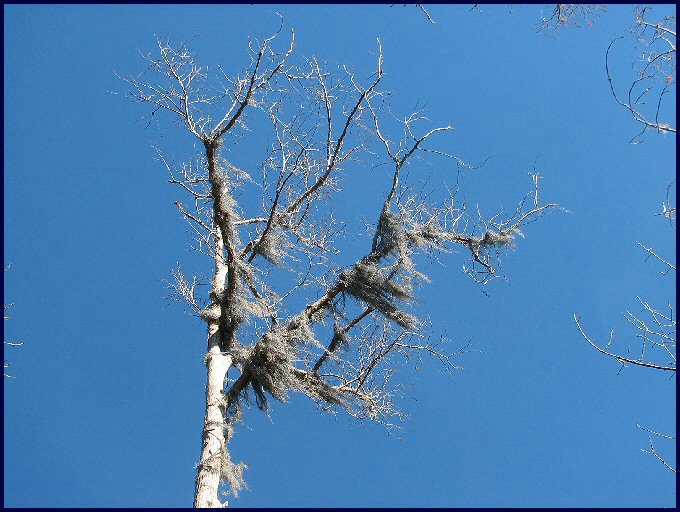
The park, as you can see, has suffered. The cypress knees huddled together remind me of a childhood book I loved, The Singing River, but the bare limbs from which the Spanish moss waves heroically signal hurricane destruction. It's the south, and the trees have no business looking like the ones at home this time of year.

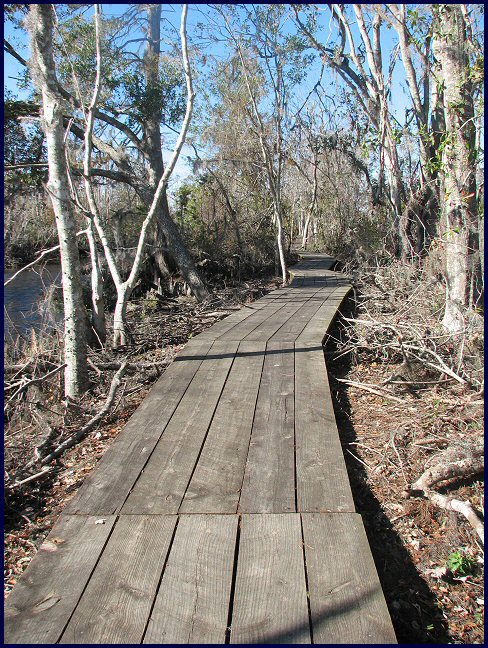
I walked a mile or so along a path through the swamp, one of the few open to hikers even five months after the storm, and then another mile or so on the boardwalk that parallels an old canal. The yellow-rumped warblers that will find their way back here in May were much in evidence, along with chickadees whose call varies just slightly from that heard in the winter woods of the north. I'm guessing that that means they were Carolina chickadees instead of our own black-capped chickadees.

No alligators, and only the occasional human. I am so grateful for places like this Preserve, where I can be alone with my thoughts and the wide swath of world to which human delight and loss are alike irrelevant.

Down along the canal, a great egret hunted hungrily, and a muskrat so enormous that I at first thought she was a beaver feasted on waterlillies. The little blues were more elusive. In St. Augustine, there are places along the river where you can sit at sunset and watch them sailing in flocks to secret overnight haunts. If there are still flocks of them in southeastern Louisiana, they did not make themselves known to me. But there are solitary survivors, testamentary to the quiet will of nature even in the face of its own most devastating onslaught.

Saturday, January 28, 2006

Some Things Don't Require Many Words


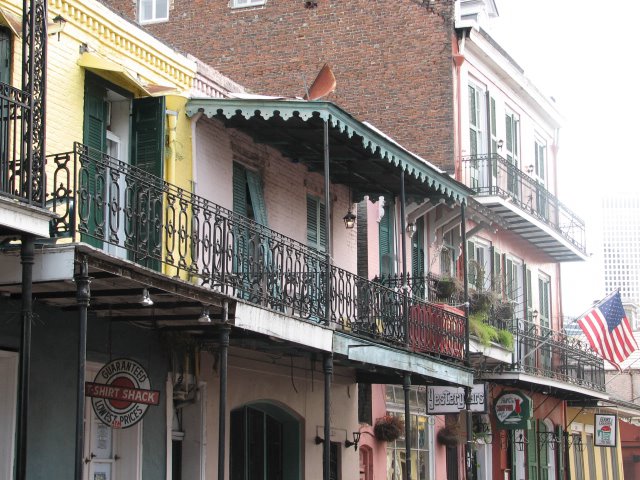
Jackson Square -- might look familiar as the backdrop to some sweeping Presidential promises.
One of the world's most fanous streets -- quiet on a Sunday morning, but it will rise again.
A t-shirt hanging in a Bourbon Street storefront.
And if you're in the mood for many more words, go here. Jazz great Wynton Marsalis made quite a Martin Luther King Day speech at Tulane University.

Wednesday, January 25, 2006

Formation Out Of Water


New Orleans, situated above the snake-like curve of the Mississippi River and below the enormity of Lake Ponchartrain, is a city of the water.

When the Americans began to pour into the city after the Louisiana Purchase in 1803, they discovered that the French, long ensconced east of Canal Street, were eager neither to make their acquaintance nor to welcome them into New Orleans society or government. However, there were fortunes to be made as tarriff regulations vanished in the wake of the takeover by the new little American nation and the port of New Orleans opened to trade with Europe, the eastern United States, and the western frontier. The Americans weren't going anywhere. They settled west of Canal Street and began to build their own culture, across from the "neutral zone" where peoples of all nationalities could set up necessary encounters, and a distance from what we know today as the French Quarter.

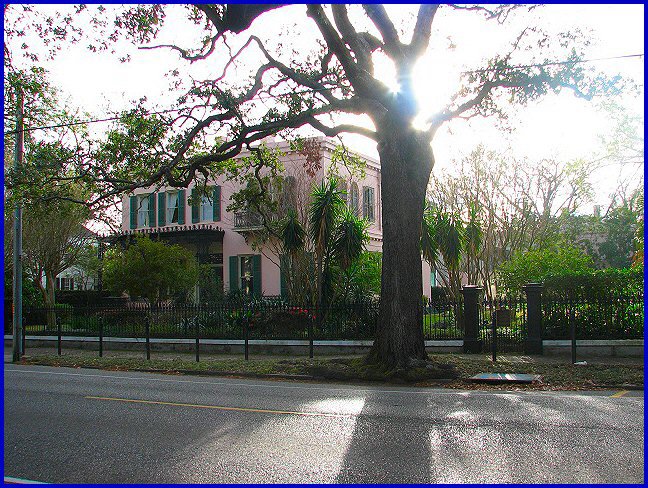
The small prestigious American enclave benefitted from Mississippi floodwaters of the early 19th century, which deposited a thick layer of silt as they seeped away. The silt destroyed sugar plantations, but created high ground for houses and fertile ground for gardens. Hence, the birth of the Garden District. I was fascinated to learn that a natural and economic disaster not so different from Katrina had created the circumstances under which a neighborhood flourished in the decades following and was largely preserved when, 200 years later, a few inches of ground meant the difference between salvation and inundation.

As is evident from the last photograph, the Garden District did not emerge from Katrina entirely unscathed. The mansion in the bottom picture, encased in scaffolding, exists entirely under the auspices of a historical slate company from Cincinnati at the moment. One of New Orleans' most famous restaurants, Commander's Palace, has a long and difficult comeback ahead -- its sign says "We Understand."

But other homes remain mostly intact, a blue tarp here or there the only obvious sign of what happened. Perhaps there is something to be learned from the results of the flood that created the Garden District.

Thursday, January 19, 2006

Respite

Southeastern Louisiana is not all turmoil and devastation. Egrets and herons still stalk the bayous, and chickadees and warblers still flit among the cypress and palmettos.

I'm headed out of town to visit family and take a look at an employment opportunity, and I'm returning Saturday to a stack of papers to grade and a Sunday presentation on Ignatian spirituality for our church adult education class, a church luncheon, and the annual meeting.

So it will be a few days before I pick up my New Orleans series again. If you haven't read it, I hope you'll look back at my week's writing. I'm not participating in NOLA rebuilding, but I'm trying to do what I can by sharing the story as I witnessed it. Please share a comment if any of the entries makes an impact on you.

And a minor update: my daughter seem energized by her first week at Tulane. She's thrilled that her urban sociology class will offer her a chance to do fieldwork in the neighborhoods of her new city along with opportunities for service learning with local agencies. I'm thinking she's doing just fine.

Wednesday, January 18, 2006

Heading South (Click on Photos to Enlarge)


"Go down to Buras and you'll really see what Katrina did." So said another set of Tulane parents whom we met, all of us with freshmen daughters in tow, on the Jazz and Jambalaya Riverboat Cruise the University hosted for new families last Thursday night. This particular family was from Buras, much of the way down Route 23, where they are in the oyster business. (Hear that, Paul?) Their house is unlivable, so they are residing in their 65' cabin cruiser and thinking about turning down the trailer for which they've finally been approved, since the boat is quite comfortable. I had hoped, in pre-Katrina days last summer, to travel down Route 23 to the National Wildlife Refuge at the end of the finger-like pensinsula stretching southeast of New Orleans. They told me I would probably not even be able to reach Buras but that I should try if I really wanted to see what Katrina had wrought.

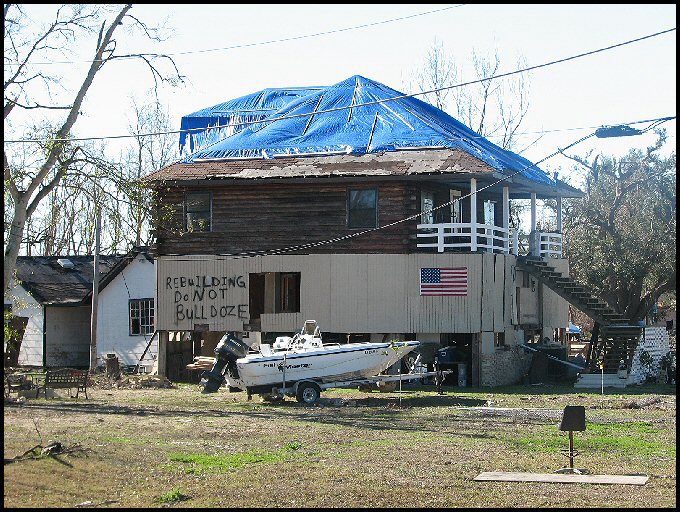
Saturday dawned bright and sunny and I headed south, a little nervous since I am entirely unfamilair with the area. I did, in fact, make it to Route 23 pretty much entirely by chance, but make it I did. Of the dozens and dozens of vehicles speeding down the highway, I was almost the only passenger car. Truck after truck followed the road south -- most of them going much farther than I was able to since I was, indeed, stopped and ordered to turn around at a checkpoint about 10 miles north of Buras.

The trip is a bizarre one. There are stretches of highway bordered by lovely small estates, with pastel-colored stucco homes sporting long verandas worthy of Southern Living cover photos and carefully manicured lawns. And then there are the stretches where Katrina altered everything.

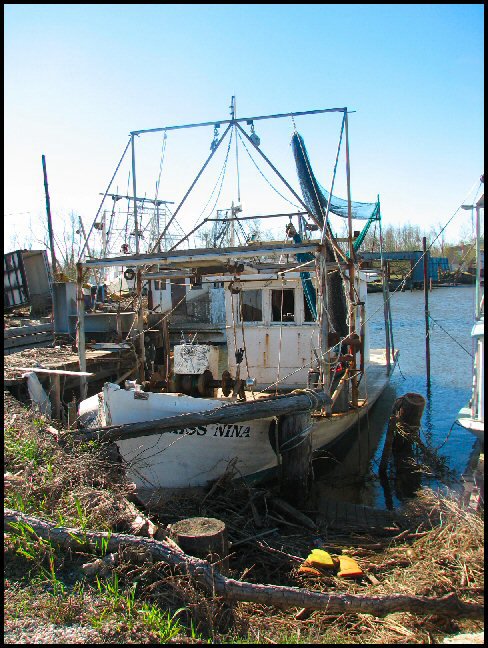
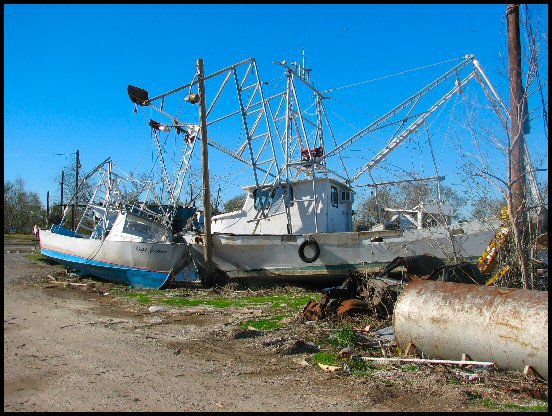
Boats rammed into bayou banks, boats hurled on top of each other, boats upside down in ditches.

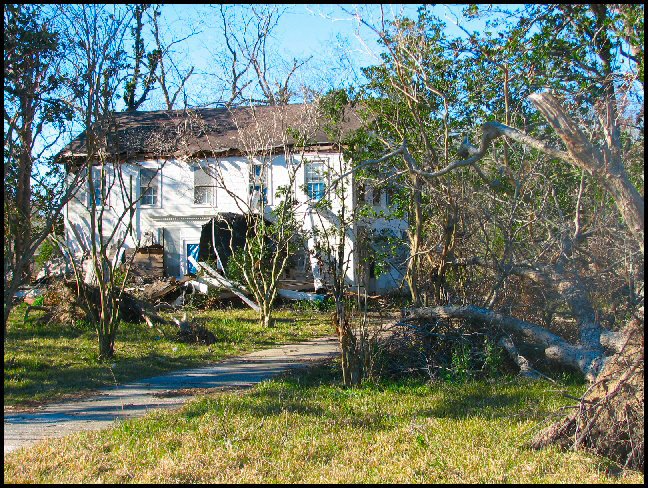
Buildings surrounded by fallen trees, buildings with roofs and siding ripped off, buildings crunched and sagging into twisted skeletons of their former selves.

Houses flattened, or blown off their foundations and up to the highway.

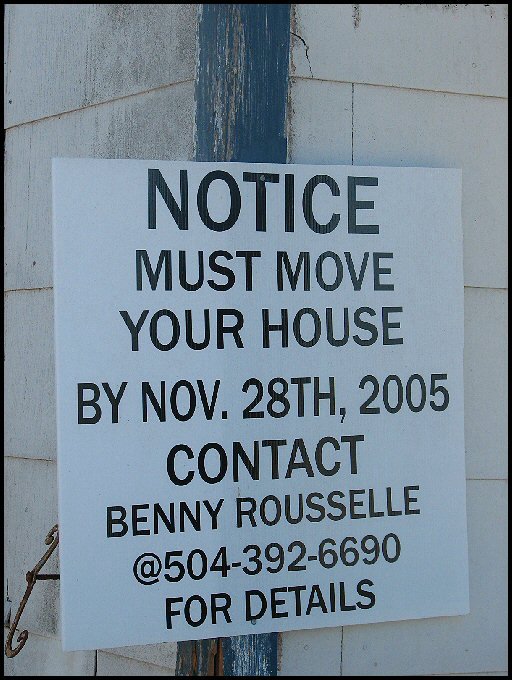
Signs:

Must Move Your House.

Asbestos No Removal.

Call So-and-So.

John and Lucille, 1141 [Disappeared] Lane

Rebuilding Do Not Bulldoze

Report Animal Sightings Please

The trucks that accompanied me south looked like little matchbox playthings in contrast to the sheer vastness of material that must be removed and landfilled and somehow replaced.

I was struck repeatedly by indications of how much courage and determination will be required to rebuild this area. The homes were not vacation mansions on stilts such as those built by northerners and city-dwellers along the Outer Banks in defiance of all reason and sense. These were the homes of small businesspeople and their employees, the homes of people who loved to make their lives along the Gulf. I'm sure you don't have to be someone like me who's dreamed of a life along the water to be pained by the sight of houses, docks and boats blown to bits, and the hopes and expectations of Gulf families along with them.
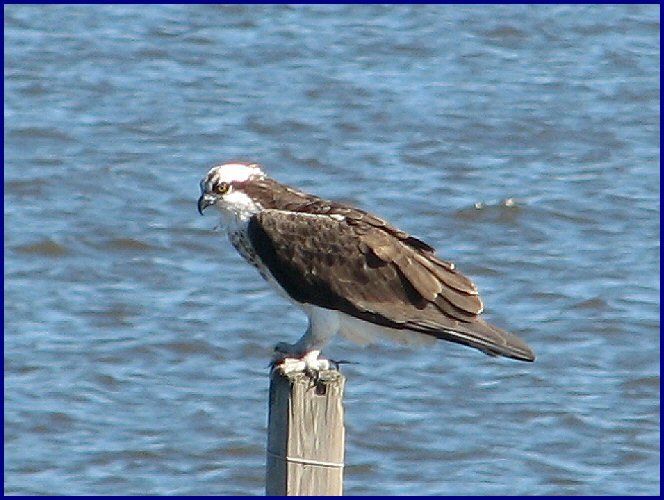
Paul mentioned yesterday that the osprey looks mythic. To me, he seems in this photo to be challenging us:
Fix it.

Tuesday, January 17, 2006

Southeastern Louisiana: A World Apart


"9/27 CAT RESCUED."
That's what I saw spray painted on a small house in New Orleans.

I had expected that my first look at what was left of southeastern Louisiana would be from the air, but overcast skies prevented me from seeing anything until my plane landed. The gray day did nothing for my spirits as my taxi took me to Tulane, and I was immediately immersed in the chaos of a college reawakening after its semester off, so I had little time at first to take in much in the way of hurricane damage.

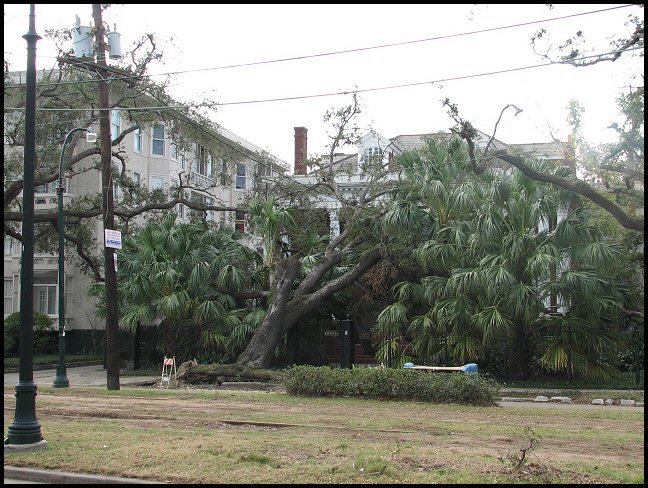
My first view of serious Katrina impact was of the tree in the first photograph above, blown down and against a St. Charles Avenue mansion. Nearly five months later it still lies there, in all of its former live oak glory. My guess is that the home behind it remains in good shape, so no one is going to turn limited resources toward its removal.

The next day we hopped on a bus for a city tour provided for Tulane parents. Most of the morning was designed to acquaint us with NOLA history and architecture (more on that to come later this week), but some parents asked for a trip to areas where the hurricane had done its worst. Our guide indicated that she had been told to stick to the usual tourist routes, but she acceded to the requests and took us out to the West End, to the suburb of Lakeview, bordering Lake Pontchartrain. (If I am a little off on geography and names, I apologize and gladly await corrections from NOLA readers.)

Imagine your home. Think about what you do there. You grab meals on the run from the frig. You spread your bills out on the dining room table. You sit around and watch tv in the evening. You clean the bathrooms and rake the yard. You roll your eyes when the phone rings and it's always -- always -- for a teenage member of the household. You take the dog for a walk. You spread the best china and silver and welcome friends and family for a holiday dinner. You sit down at the kitchen table for a heart-to-heart with a child who came in too late last night, or a parent contemplating a move to a retirement community. You arrange fresh flowers for the mantle and call the piano tuner.

Unless you live in Lakeview, in which case you don't do those things anymore.

Lakeview is an eerie reminder of the destruction wrought by Katrina. Street after street of middle-class homes, pleasant brick ranches and colonials, water-stained and vacant. Disorienting. You feel for a moment that you are in a construction site, host to a new development of homes not yet completed or furnished, and then you are quickly brought back, by a water line on a fence, or a pile of trash and applicances, to the reality that this is a place of de-struction. There is no con-struction. The streets are silent, empty. There is none of the comdraderie and laughter of neighbors dealing with yet another home maintenance disaster of the type those of us who live in older cities are accustomed to -- there are no neighbors. There is no plumbing to complain about. No electrical. No heat. No dogs.

I don't have any photos of the West End -- the bus didn't stop there and I decided to cover more ground the next day rather than retracing my steps. (The other four pictures in this entry, including that of the unperturbable osprey, were taken further down the coast.) But I am haunted by what I saw. My husband said that he thought he had read somewhere that Lakeview was, like our own city, one of the first suburbs in America racially integrated with some degree of success, and that there was a great interest in returning it to life. I thought about Lakeview when I went to the gym this morning, where the population was a pretty even mixture of black and white, and where the few skinny babes in stylish workout clothes were offset by the Orthodox Jewish women pumping away on the Ellipticals in their ankle-length skirts, long-sleeved t-shirts, and head coverings. I thought about my neighborhood, with its eclectic mix of elegant older homes, somewhat out-of-place ranches, apartments, funky shopping blocks, modern schools, and extensive parks. I thought about it all just being gone. About all of us being gone.
The news in New Orleans is all recovery-related. Signs posted everywhere advertise clean-out and tear-down and haul-away services. The mayor says in exasperation that the destruction is God's punishment. You might almost think so, if you were inclined that way. It does tend to bring Noah to mind.
And God's wrath or not (and no, that's not my way of thinking), the wake of Katrina does clarify why the ancient stories of floods, common to virtually all civilizations, retain such a hold on us thousands of years later. The damage is awesome and the silence is deafening.

Wednesday, January 11, 2006

Unexpected Everything

One of the first things you discover when you have children is that you will be happier if you abandon all expectations. Nothing will ever go according to plan again, and your vision of control is little more than fantasy. Such realities perhaps become apparent to parents of multiples more quickly than to most other parents, but they do come to all of us, sooner or later.
College? Now THAT seemed somewhat under control. A Herculean task, to be sure, but a manageable one, as long as you do not mistake your own completely unbiased and adoring view of your child for the more jaundiced one that might be taken by admissions committees. A couple of reaches, sure -- but on the whole you and your child try to figure out what her realistic options might be and arrange things so that when the letters come, there are more acceptances than rejections and at least some of them offer something enticingly green. She makes her choice, she refrains from the kind of idiotic behavior that could get her expelled from high school in May, and she goes off to college.
So who thought about a hurricane?
Nope, not me. I just laughed at the "Personal Hurricane Emergency Preparedness" information that came along with the phone cards and post office box numbers and refrigerator orders.
Why would a woman who had to single-handedly evacuate three children under four from the house late one night when the church next door burst into flames EVER laugh at the possibility of disaster?
What can I plead? Undying optimism?
Well. My daughter and her father are back in NOLA this afternoon. Both of them, of course, have their phones turned off, so if something worse than Katrina has happened I don't know about it yet. I assume they're exploring and I hope they're safe. Tomorrow she'll get a look at her new dorm room and will learn whether her clothes and bedding survived the past four months, and then she will, once again, begin her career at Tulane.
She has certainly grieved the loss of Willamette, her first semester host school, and her wonderful group of friends there. But last night she was online purusing the array of volunteer and rebuilding opportunties available in New Orleans and wondering how she was ever going to choose what to do. I think she'll probably be all right.
**************************
PS: I'm flying down tomorrow and I'm staying till Sunday. "You're not planning to hang out with me all the time?" asked the lovely daughter. Are you kidding? My cameras are primed and I have hundreds of photographs to take. I plan to see as much of NOLA and southeastern Louisiana as I can. More next week!
***************************
PPS: They called! And here's the first report: No, it's not the NOLA they visited a year ago. Trolley cars? Gone. Street lights? Nope. Traffic lights? Mostly down. My daughter says it probably would be depressing, but there are lots of people around. French Quarter: There, but very quiet. Hotel? Sheets covering the windows, room ceiling pulled down, no hallway wallpaper anywhere, endless evidence of blown-out windows and water damage. "Spartan, " says my husband. However, there are lots of parents and students wandering around. My daughter does not sound the least bit deflated.
To my utter dismay, they also report that the President (of the United States) is coming to New Orleans tomorrow. Honestly. This administration's contribution to the recovery of a great American city equals less than zero. How dare he show his face just when the colleges -- among the few institutions that have made real headway, and almost completely on their own steam -- are re-opening? No one needs a presidential entourage impinging upon things tomorrow. Let the university communities have their day in the sun.

Friday, November 18, 2005

High Tech

If you saw me, you would know. I mean it -- you would really KNOW. I am so not functional in this century.

And yet, surprisingly, I am. I am sitting here in the dining room, where books and papers are crammed into and onto every surface, where my great-great grandmother's china sits in the cupboard, and where a cat making funny little brrrrpiiiiing noises is perched on a carpet on a hardwood floor, with all her feet tucked under her. The only concession to the modern world is this little gadget on which I am typing away with my two index fingers.

So here's what I've done today to justify my presence in the century in which I happen to live -- besides work and yes, I did do a tiny bit of that. If I hadn't gone there, I couldn't have accessed my lonely AOL journal to send people here.

1. I added links! A few at a time. It's an arduous process but I'm getting the hang of it.

2. I moved some entries over. That process isn't any easier.

3. I cleaned out my AOL cookies and cache, whatever on earth that means, and had a very pleasant exchange with AOL Joe, who is indeed trying to share helpful (albeit ultimately useless) assistance with respect to the problem of saving AOL entires.

4. I did write a new AOL entry, and stashed it in Joe's comment section. It's about how advertising really is a significant social issue for the 21st century. Unfortunately I have no idea how to do in-text links over here yet, so if you want to read it -- well, you'll just have to go look for it. It wasn't all that good or even interesting, so you probably won't want to bother.

5. I navigated the Tulane University website and made several phone calls to some lovely folks in New Orleans in a (succcessful!) attempt to find the college course description catalog online -- now THERE's an internet task. My lovely daughter in Oregon is now registered for classes in Louisiana with a little help from her mom in Ohio.

6. In the process of muddling my way through the various Tulane links, I learned that several people might not be available to help me this late Friday afternoon because they were throwing a bon voyage party for a colleague who lost her house and all its contents.

So don't worry about my inability to distinguish between the significant and the trivial. Every time I call New Orleans, I am reminded how lucky I am to have the dining room, the books, the papers, the china, the carpet, the floor and, most especially, the cat.