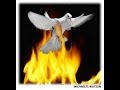
Seven Stanzas at Easter
~ John Updike
Make no mistake: if He rose at all
it was as His body;
if the cells’ dissolution did not reverse, the molecules
reknit, the amino acids rekindle,
the Church will fall.
It was not as the flowers,
each soft Spring recurrent;
it was not as His Spirit in the mouths and fuddled
eyes of the eleven apostles;
it was as His flesh: ours.
The same hinged thumbs and toes,
the same valved heart
that–pierced–died, withered, paused, and then
regathered out of enduring Might
new strength to enclose.
Let us not mock God with metaphor,
analogy, sidestepping, transcendence;
making of the event a parable, a sign painted in the
faded credulity of earlier ages:
let us walk through the door.
The stone is rolled back,
not papier-mâché, not a stone in a story,
but the vast rock of materiality that in the slow
grinding of time will eclipse for each of us
the wide light of day.
And if we will have an angel at the tomb,
make it a real angel,
weighty with Max Planck’s quanta, vivid with hair,
opaque in the dawn light, robed in real linen
spun on a definite loom.
Let us not seek to make it less monstrous,
for our own convenience, our own sense of beauty,
lest, awakened in one unthinkable hour, we are
embarrassed by the miracle,
and crushed by remonstrance.
**********
I had forgotten about this poem but, in a year in which bodies and death have overtaken my thoughts and Easter has been difficult indeed, I am glad to have found it again, along with a little bit of commentary, here.
Showing posts with label Easter. Show all posts
Showing posts with label Easter. Show all posts
Wednesday, April 15, 2009

Sunday, March 23, 2008
Happy Easter
 Easter Vigil with the Catholics.
Sunrise Service with the Methodists.
A rousing morning service with the Presbies.
He is risen, indeed!
Friday, March 21, 2008
Good Friday
 Love is most nearly itself
When here and now cease to matter.
Old men ought to be explorers
Here or there does not matter
We must be still and still moving
Into another intensity
For a further union, a deeper communion
Through the dark cold and the empty desolation,
The wave cry, the wind cry, the vast waters
Of the petrel and the porpoise.
In my end is my beginning.
T.S. Eliot
The Four Quartets
Thursday, March 20, 2008
That Blend That Is My Life
I had kind of a wonderful thing happen tonight.
A former student of mine called, a young lady who must now be in the 11th grade in the Orthodox Jewish school in which I taught. I haven't seen her in months. Her question: She had agreed to babysit for a Christian family on Easter Sunday and to help prepare their Easter dinner, and then had begun to wonder whether her participation in a Christian meal could be construed as supporting or promoting the Christian faith and, therefore, a violation of halacha (Jewish law). She had already consulted a rabbi, who had told her to find out whether Easter dinner constitutes a religious celebration.
We talked for quite awhile. I explained that for most people, an Easter dinner is merely a family-and-friends event, with no religious overtones and certainly no ritualistic aspects. On the other hand, if the family were religious, there might be a prayer, and the prayer would likely be an expression of gratitude for the risen Christ, and that would likely be a problem for her. I suggested that she ask them about their practice.
Then, as we continued to discuss various scenarios, I began to reformulate the problem. "You know," I said to her, "this is THE celebration of the Christian year. This is what it's all about for us, and this is also the day on which the distinction between Christianity and Judaism is grounded. This is the day most like Rosh Hoshana and Yom Kippur in its centrality to our religion, and this is the day on which we claim the belief with which you completely disagree."
"So," I continued, "even if the family in question is not what you would term 'observant'; even if there is no ritual, no prayer, and no other acknowledgment of the religious significance of the day; even if it appears on the surface to be an entirely secular occasion ~ the belief underlying it constitutes the foundation of the Christian faith. The question then becomes whether, recognizing the significance of the day, even if the family does not, is it acceptable for you to participate in any way? That's what you need to ask Rabbi B."
"I feel so bad," she said. Hmm, backing out of a holiday babysitting job with only four days notice is not good. That's what I thought, as a once-mother of small children who knows how hard it is to come by a reliable babysitter. "I think you need to honor your religion," is what I said out loud.
I was honored to be brought into the discussion, and I asked her to call and let me know how she and the rabbi resolve it. I have to say: it's pretty cool to be trusted by a Jewish teenager to provide the discussion and straight answers (and more questions) that she needs to resolve a religious dilemma that is no doubt difficult for her to pose.
Not a bad prelude to the holiest days of our year.
Sunday, April 08, 2007
Happy Easter II !
Christmas . . . oops! Easter Morning: The Cemetery, The House, The Church
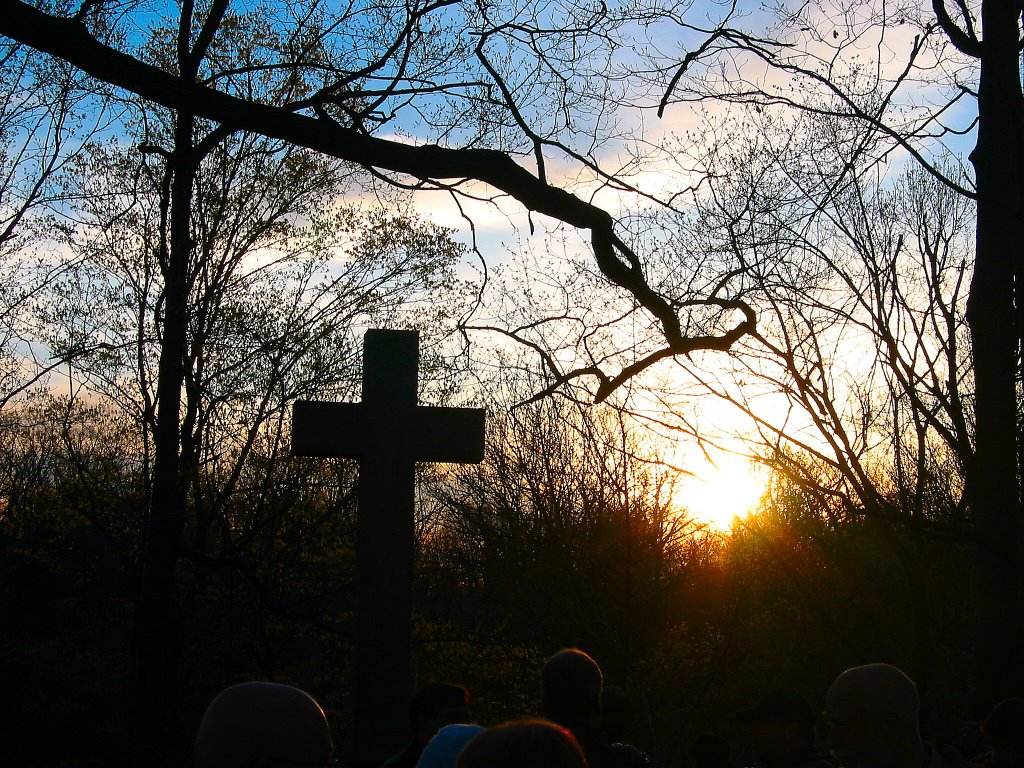
Fortunately, as a product of both the Celts AND the Scientific Revolution, I know that the sun did rise, in a manner of speaking, behind that cross this morning. Here it was last year.
Fortunately, as a product of both the Celts AND the Scientific Revolution, I know that the sun did rise, in a manner of speaking, behind that cross this morning. Here it was last year.


Happy Easter I !
 This morning in the midwest doesn't look anything at all like Washington National Cathedral did a week ago, with the trees about to burst into bloom and the sunlight through the stained glass casting color upon stone. My daffodils and tulips are completely ~ and I do mean completely ~ covered by snow which, when I let the dog out a few minutes ago, I discovered to be still falling in some strange form. I am off to the Sunrise Service, which I wouldn't miss on a day like this for anything, although I admit that since the cemetery is only a couple of blocks away, I am spared the dilemma of whether to clean off a car and risk getting stuck in the driveway to get there. I can just walk over, and hope that others find a way to make it, too. I'll post an image or two later. Thick socks, snow boots, and fleece everywhere ~ Happy Easter!
Thursday, March 29, 2007

Sunday, March 25, 2007

Tuesday, April 18, 2006
Easter: A Look Back
I started my observation of Holy Week with a question: what was God able to do in the human form of Jesus that God could do in no other way?
Visit with friends; have dinner; humbly wash the feet of his companions; share his brokenness with them; experience abandonment and betrayal; suffer the indignities and humiliations of arrest, questioning, trial, sentencing; know the fear and actuality of physical suffering and death. And that list represents only the briefest summary.
In the Bible as many of us learn it, God begins as the intimate companion of God's human creatures and gradually becomes an increasingly distant presence. It has long seemed to me that in the creation stories, it is a lonely God, longing for companionship, who creates human beings. God is actually walking through the garden in the cool of the evening, seeking them out, after their disastrous encounter with another earthly presence. As the writings of the Jewish Bible unfold, God gradually removes himself from the intimacy of those early relationships. He talks to the Jewish people through Moses and travels with them as a pillar of fire. He makes the prophets thoroughly miserable. In some of the most personal stories -- those of Ruth, Esther, Joseph -- he appears through the lens of interpretation of the protagonists. And when he speaks directly to Job, it is not to lament their broken relationship, but to ask him, out of the whirlwind, how he dares to question the powerful Creator.
I try to steer clear of the distinction Christians have so often made between the "angry and vengeful" God of what we call the Old Testament and the "loving and forgiving God" of the New. I hear that dichotomy stated frequently by adults in my own church and, when I do, I'm thankful I missed out on all those years of Sunday School indoctrination and got to approach the issue as an adult. The Jews see God's self-revelation in Torah as loving and forgiving, as Christians see God's self-revelation in Christ. And there's plenty of anger and boistrous righteousness in the New Testament for me.
But it is clear that something happened in the intervening centuries between the last compilation of Hebrew scriptures and the first letter of Paul. I asked one of my pastors once if she thought God had actually changed his mind about how to relate to human beings somewhere along the way , and she told me that I had stumbled upon one of the major debates of the contemporary church. Is God all-powerful, all-knowing, and unchangeable? Or is God someone we don't understand and those adjectives, like all others, cannot do God justice?
I don't know much about the theological debate, but I do tend to think that God changed his mind. Or at least had a new idea. As a human being, God would have experiences different from any that he could know as Creator or Spirit. "Walk a mile in someone else's shoes before you judge them," my father used to tell me when I was a little girl. Not such an original idea. Maybe at least 2000 years old.
**********
I started this entry back on Sunday, and then got derailed by the death of Pamela Hilger. Several people wrote about how her death on Easter Sunday had a special meaning for them. I thought about that, but I couldn't write about it. I had already been writing about how the time period after a death is so bizarre and confusing in the context of Mary Magdalene's experience, and about Easter morning in the cemetery here, and I decided to leave it at that. Because bizarre and confused and disoriented and so very sad were just how I felt.
And those feelings would be part of the answer to the question as to what God could experience as a human being and no other way.
Sunday, April 16, 2006
Easter VIII
It was something of a disorienting experience to walk over to the cemetery for the Sunrise Service this morning.
Although I love to take my walks there, I don't usually give that much thought to its primary purpose. My adult kids are grossed out -- "Mom, there are gravestones all over the place and underneath them, there are bodies! How can you walk there?"
"The worms go in, the worms go out..." I sing back as they roll their eyes.
Seriously, the place is an arboretum as well as a cemetery and, with the number of locally famous people buried there, it's a historical site as well. And, since I have been living here for more than 20 years now, it's also the final resting place for an increasing number of people whom I knew. But I don't focus much on that latter aspect and, when I do, I am well aware that what lies underneath me are the remains of bodies. Bodies of people who are not coming back here.
Although I love to take my walks there, I don't usually give that much thought to its primary purpose. My adult kids are grossed out -- "Mom, there are gravestones all over the place and underneath them, there are bodies! How can you walk there?"
"The worms go in, the worms go out..." I sing back as they roll their eyes.
Seriously, the place is an arboretum as well as a cemetery and, with the number of locally famous people buried there, it's a historical site as well. And, since I have been living here for more than 20 years now, it's also the final resting place for an increasing number of people whom I knew. But I don't focus much on that latter aspect and, when I do, I am well aware that what lies underneath me are the remains of bodies. Bodies of people who are not coming back here.
So yes, it was disorienting, after all these months spent so intensely with the human Christ via the Spiritual Exercises, to walk into the cemetery and see it in a new way, to see it as if it were that cemetery outside Jerusalem so long ago, a cemetery in which someone did actually come back here. I had never really grasped before how completely unexpected the appearance of Christ must have been to those who saw him that morning. I'm sure I don't grasp that yet.
(Think about it. Think about the most recent death of someone close to you. In no way, shape, or form do you expect to see that person sitting on his or her gravestone if you go to visit it.)
And so then, Christ? Someone not quite so human anymore? Have I entered a different realm at this point in the Exercises? Or was I always there and just not too clear on that point?
I'm a bit flummoxed. I'm sorry I got so far behind on my retreat by getting sick and missing most of the month of March. Although I'm on my own schedule, not trying to keep in step with a group, I wish I had gotten through more and reached Holy Week in the Exercises at the same time that we reached it in real life. Maybe I would have been better prepared for this morning. But, maybe not. Maybe it's not something you're ever prepared for.
Easter VII

Mary Magdalene went and announced to the disciples, "I have seen the Lord."
(John 20:18)
Mary Magdalene, the first preacher in the Christian church. Sometimes called the Apostle to the Apostles.
When I went to the sunrise service this morning, hosted by four Methodist churches in the cemetery where I so often walk, I still had Mary Magdalene on my mind.
And then it turned out that all four pastors officiating at the service were women. Two African-American, one Korean, one WASP -- all women.
Their presence seemed particularly meaningful to me today.
Saturday, April 15, 2006
Easter V
4:00 pm
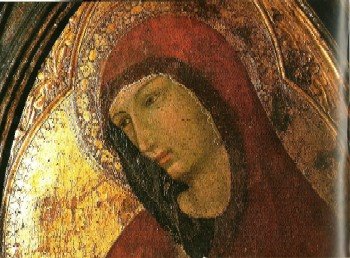

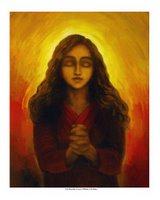
As a Jewish woman on an early Friday evening in the spring, she must have been frantic in her grief and her desire to reach the tomb and take proper care of the body. It takes so long to get dark -- almost 9:00 -- and then, unable to work on Saturday, she would have had to wait until daybreak Sunday to leave the house safely. The day or two after a death is always bizarre and confusing; it's easy to imagine Mary and her companions trying to comfort Mary the Mother of Jesus and at the same time approaching the edge of rationality themselves.
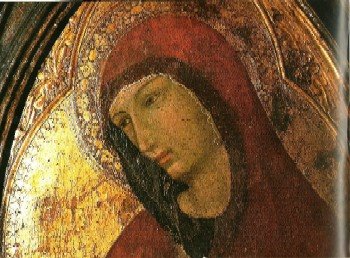

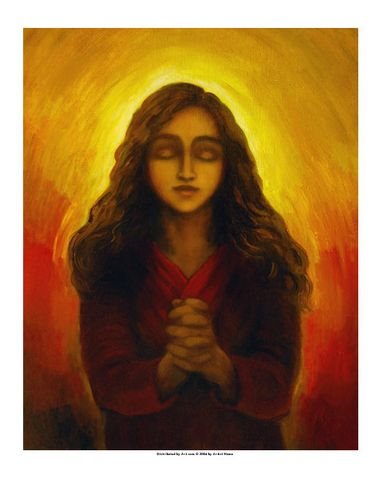
No, I didn't forget about the women. I did go back and look at the gospel accounts of Thursday night, and the only women I could find were the woman with the alabaster jar who appears prior to the Last Supper and the servant girl who afterward provides the occasion for Peter's first denial of Jesus.
But on Friday, as Jesus is formally tried, sentenced, forced through the streets of Jersusalem, crucified, and dies, the women who know him are in evidence, among them Mary Magdalene.
I like Mary Magdalene a lot. I like a woman who goes where she wants to go on her own, asks a lot of questions, and pays close attention to the answers.
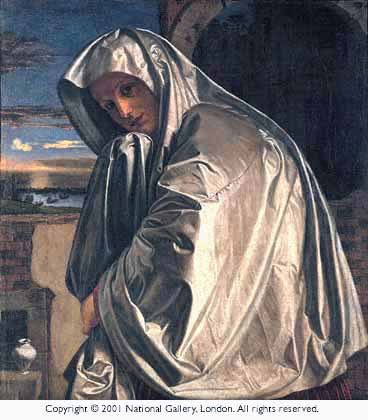
So today I started looking for how she has been painted through the ages. She appears as an Eastern Orthodox icon, hair and body fully covered and looking severely at her observer, a serious elder of the church. She is portrayed in some Renaissance paintings as decidedly lacking in clothing, presumably due to her unfortunate mischaracterization as a prostitute by a pope hundreds of years earlier. But there are also some portraits in which she looks more as I would imagine her: solemn, sad, understanding that she is caught up in something beyond comprehension.
But on Friday, as Jesus is formally tried, sentenced, forced through the streets of Jersusalem, crucified, and dies, the women who know him are in evidence, among them Mary Magdalene.
I like Mary Magdalene a lot. I like a woman who goes where she wants to go on her own, asks a lot of questions, and pays close attention to the answers.
So today I started looking for how she has been painted through the ages. She appears as an Eastern Orthodox icon, hair and body fully covered and looking severely at her observer, a serious elder of the church. She is portrayed in some Renaissance paintings as decidedly lacking in clothing, presumably due to her unfortunate mischaracterization as a prostitute by a pope hundreds of years earlier. But there are also some portraits in which she looks more as I would imagine her: solemn, sad, understanding that she is caught up in something beyond comprehension.
As a Jewish woman on an early Friday evening in the spring, she must have been frantic in her grief and her desire to reach the tomb and take proper care of the body. It takes so long to get dark -- almost 9:00 -- and then, unable to work on Saturday, she would have had to wait until daybreak Sunday to leave the house safely. The day or two after a death is always bizarre and confusing; it's easy to imagine Mary and her companions trying to comfort Mary the Mother of Jesus and at the same time approaching the edge of rationality themselves.
Friday, April 14, 2006
Easter IV

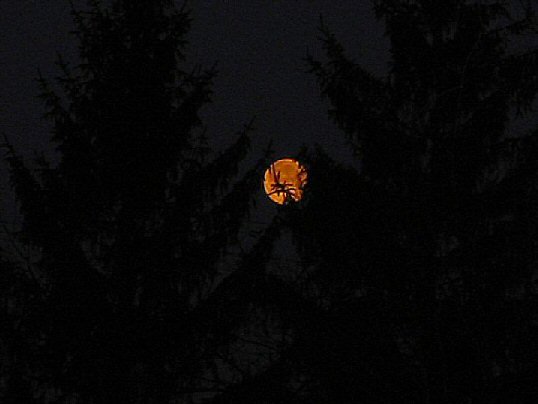
I'm way too tired to write tonight, but I think that the above image from the Shining Rock (NC) webcam is an appropriate one for Good Friday.
Easter III
9:45 am ~
I can't believe I'm even awake. It was nearly 1:00 this morning when the Seder ended, and then my son, home for Part III of the Dental Disaster Recovery Effort, and I stayed up another hour and a half talking in the kitchen. And I talked to my daughter, who's in Oregon for the long week-end, visiting her Katrina-semester college friends and trying to decide whether to transfer back. Of course, it was three hours earlier in Oregon.
Holy Week and Passover take place in the context of the real world, as they always have.
The Tenebrae Service at our church early in the evening was quiet, solemn, and moving. Tenebrae means "shadows," and apparently many churches use that service for Good Friday, but it's also an appropriate service for Thursday night. As we progress through communion and several readings of the beginning of the Passion Story, the seven candles on the altar are extinguished, one by one, and then finally the Christ Candle, first lit on Christmas Day, is also extinguished. At the end of the service, the paraments -- the various fabrics used for the altar, lectern, and pulpit -- and the pastors' vestments -- all of which are Lenten purple this week -- are all removed as silence and darkness descend.
As I have been looking around online, I have come to realize that Protestant churches often skip the observances of Holy Week, as they do any significant acknowledgement of Lent. We tend to be uncomfortable with images of darkness and reminders of evil. In Advent we read from the prophet Isaiah and the Gospel of John that "the light shines in the darkness and the darkness did not overcome it," and we want to stick with that. We don't want to think of a world encased in a shroud of seemingly inpenetrable hatred even for three days.
I can't believe I'm even awake. It was nearly 1:00 this morning when the Seder ended, and then my son, home for Part III of the Dental Disaster Recovery Effort, and I stayed up another hour and a half talking in the kitchen. And I talked to my daughter, who's in Oregon for the long week-end, visiting her Katrina-semester college friends and trying to decide whether to transfer back. Of course, it was three hours earlier in Oregon.
Holy Week and Passover take place in the context of the real world, as they always have.
The Tenebrae Service at our church early in the evening was quiet, solemn, and moving. Tenebrae means "shadows," and apparently many churches use that service for Good Friday, but it's also an appropriate service for Thursday night. As we progress through communion and several readings of the beginning of the Passion Story, the seven candles on the altar are extinguished, one by one, and then finally the Christ Candle, first lit on Christmas Day, is also extinguished. At the end of the service, the paraments -- the various fabrics used for the altar, lectern, and pulpit -- and the pastors' vestments -- all of which are Lenten purple this week -- are all removed as silence and darkness descend.
As I have been looking around online, I have come to realize that Protestant churches often skip the observances of Holy Week, as they do any significant acknowledgement of Lent. We tend to be uncomfortable with images of darkness and reminders of evil. In Advent we read from the prophet Isaiah and the Gospel of John that "the light shines in the darkness and the darkness did not overcome it," and we want to stick with that. We don't want to think of a world encased in a shroud of seemingly inpenetrable hatred even for three days.
Maundy Thursday services are short and spare, but emphatic. At our church, one of the pastors welcomed us to communion , as he always does, with a reminder that Christ's love is for everyone -- male and female, white and black, gay and straight, Christian and Jew and Muslim, every single person in the human family. That message never goes without saying in our church. But by the end of the hour it is clear, in the silence and the darkness, that evil and disintegration and division can overwhelm the light if we are left to our own devices.
Thursday, April 13, 2006
Easter II
5:00 pm ~
I don't, as a rule, go to Maundy Thursday services. Maybe a couple of times in my life. This year is different, for a variety of reasons, although I have to admit, I'm a bit hesitant to write about it. The peals of laughter elicited by my Ash Wednesday Service entry, when I wrote about the veritable feast provided at out church prior to the service, in genuine innocence of the fact that certain readers had been taught to lean in the direction of fasting rather than feasting prior to penetential moments, has been etched into my memory. Looks from the church calendar like there's another pre-service dinner tonight. OK, I'm not going there, either literally or figuratively.
Anyway, today I skimmed through the Borg & Crossan section on Thursday, which was helpful in terms of sorting out the varying accounts of the Last Supper strewn across the four gospels and in developing a theme of failed discipleship as emerging from the Gospel of Mark. It seems that this is the year for Mark in the lectionary, so it's helpful that Mark is the focus of that particular chapter in the book. However, the authors do skip back and forth among all the gospels, and remind us that Thursday night is packed with action, with events that have been retold so many times that it's a surprise to find that they all happened within a few hours of one another: the Last Supper, the washing of feet and the first communion, the night in Gethesmane, the sleeping disciples, the arrival of the Roman soldiers with Judas, the trumped-up inquisiton of Jesus, the betrayal by Peter.
The focus tonight across most of the western Christian world, however, is the Last Supper. Or the First Supper, depending upon how you want to look at it. I think I've written before about how I'm not a very sacramentally-oriented person, and communion is the one that has often been troubling to me. Body and blood? Do I want to eat someone's body and drink his blood, whether for real or in a symbolic way? I'm hardly the first person to raise questions about this particular ritual of Christianity, but I find that this year, as with other aspects of this faith I'm kneading into different shapes, my feelings have changed somewhat. I'm a good deal more focused on the brokenness of Christ, which means on the personhood of Christ.
Which brings make back to the question I started the day with, and a first stab at an answer. One of the things God does in the person of Christ that God can do in no other way is that God has dinner. I certainly intend no disrespect toward my Jewish friends when I say that Christ does, indeed, change some things, for people who find the Christian story credible and compelling. Insistently compelling, actually. In the Exodus story, God tells Moses how the Jews are to celebrate Pesach for millenia to come, but God doesn't join them. In the gospel story, God in the form of Jesus celebrates what is probably that same meal with his friends, as a companion, and promises to do so for the next millenia. The body and blood, the brokeness and spattering of them, make sense when we think of Christ as emphatically human. He has the same physical parts and vulnerabilities that we all do.
As far as the original event is concerned, it's kind of intriguing to wonder where I would have been. The DaVinci Code and Leonardo's ambiguous rendering of the disciple John notwithstanding, there don't seem to have been any women present at the Last Supper. That's not terribly surprising to me -- in the Jewish community, as in my own social community, men and women often do things separately. And it doesn't bother me as a feminist issue -- if we want to have a competition, well, we all know which gender group showed up at the tomb on Sunday morning. That's really not the point -- but it's an interesting question. It seems to mean that Jesus' women followers were not privy to the same information that he shared with the twelve disciples at the Last Supper. They would have learned what was going to happen later -- as it was happening.
I think I will try to fit in a quick re-reading of the Thursday night portion of the gospels, looking for women, before I head out tonight.
I don't, as a rule, go to Maundy Thursday services. Maybe a couple of times in my life. This year is different, for a variety of reasons, although I have to admit, I'm a bit hesitant to write about it. The peals of laughter elicited by my Ash Wednesday Service entry, when I wrote about the veritable feast provided at out church prior to the service, in genuine innocence of the fact that certain readers had been taught to lean in the direction of fasting rather than feasting prior to penetential moments, has been etched into my memory. Looks from the church calendar like there's another pre-service dinner tonight. OK, I'm not going there, either literally or figuratively.
Anyway, today I skimmed through the Borg & Crossan section on Thursday, which was helpful in terms of sorting out the varying accounts of the Last Supper strewn across the four gospels and in developing a theme of failed discipleship as emerging from the Gospel of Mark. It seems that this is the year for Mark in the lectionary, so it's helpful that Mark is the focus of that particular chapter in the book. However, the authors do skip back and forth among all the gospels, and remind us that Thursday night is packed with action, with events that have been retold so many times that it's a surprise to find that they all happened within a few hours of one another: the Last Supper, the washing of feet and the first communion, the night in Gethesmane, the sleeping disciples, the arrival of the Roman soldiers with Judas, the trumped-up inquisiton of Jesus, the betrayal by Peter.
The focus tonight across most of the western Christian world, however, is the Last Supper. Or the First Supper, depending upon how you want to look at it. I think I've written before about how I'm not a very sacramentally-oriented person, and communion is the one that has often been troubling to me. Body and blood? Do I want to eat someone's body and drink his blood, whether for real or in a symbolic way? I'm hardly the first person to raise questions about this particular ritual of Christianity, but I find that this year, as with other aspects of this faith I'm kneading into different shapes, my feelings have changed somewhat. I'm a good deal more focused on the brokenness of Christ, which means on the personhood of Christ.
Which brings make back to the question I started the day with, and a first stab at an answer. One of the things God does in the person of Christ that God can do in no other way is that God has dinner. I certainly intend no disrespect toward my Jewish friends when I say that Christ does, indeed, change some things, for people who find the Christian story credible and compelling. Insistently compelling, actually. In the Exodus story, God tells Moses how the Jews are to celebrate Pesach for millenia to come, but God doesn't join them. In the gospel story, God in the form of Jesus celebrates what is probably that same meal with his friends, as a companion, and promises to do so for the next millenia. The body and blood, the brokeness and spattering of them, make sense when we think of Christ as emphatically human. He has the same physical parts and vulnerabilities that we all do.
As far as the original event is concerned, it's kind of intriguing to wonder where I would have been. The DaVinci Code and Leonardo's ambiguous rendering of the disciple John notwithstanding, there don't seem to have been any women present at the Last Supper. That's not terribly surprising to me -- in the Jewish community, as in my own social community, men and women often do things separately. And it doesn't bother me as a feminist issue -- if we want to have a competition, well, we all know which gender group showed up at the tomb on Sunday morning. That's really not the point -- but it's an interesting question. It seems to mean that Jesus' women followers were not privy to the same information that he shared with the twelve disciples at the Last Supper. They would have learned what was going to happen later -- as it was happening.
I think I will try to fit in a quick re-reading of the Thursday night portion of the gospels, looking for women, before I head out tonight.
Subscribe to:
Posts (Atom)