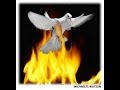
As I was driving home tonight and listening to a CD, I was captivated by the haunting quality of this music. I've heard it hundreds of times but never paid much attention when I have, as the piece is nestled within others far more familiar to me. I don't know why, but tonight it suddenly became very important to me to find the title and lyrics and context. It took quite some research, as I no longer have the CD case or insert, but eventually I came up with the title and composer ~ Funeral Ikos by John Tavener ~ and then the lyrics here, and finally some context here, as follows:
"Despite the fact that the Resurrection of Christ has displaced 'death' as the nexus of human anxieties, it still remains for us, "the" great mystery. The burial service of the Orthodox Church, despite its "assurance of things hoped for" and constant pleas for rest for the soul of the departed, gives voice to our anguish. A series of hymns (Troparia) attributed to John of Damascus (c 675- c.749 ) has been incorporated into the burial service of the Orthodox Church. The anxiety revealed is profoundly real, and engulfed in painfully human queries: Where do they (the dead) go? What do they do? Will we recognize them; and they, us? Will we speak with them? Where is their former beauty? What will become of us? Where is glory?; Where now is status? And to each set of queries, there remains only to proclaim the refrain: Alleluia ! The sequence ends with the single affirmation that, if we could but hear that there is eternal life, then our anxiety would turn to ecstasy. And with hope in Christ, we proclaim yet again: Alleluia! John Tavener (b. 1944) has always produced religious music as an important part of his output. This has accelerated since his conversion to Orthodoxy in 1977. He has explored the liturgical texts of the Orthodox Church and filtered them into the mainstream of Western choral and orchestral music."
"Despite the fact that the Resurrection of Christ has displaced 'death' as the nexus of human anxieties, it still remains for us, "the" great mystery. The burial service of the Orthodox Church, despite its "assurance of things hoped for" and constant pleas for rest for the soul of the departed, gives voice to our anguish. A series of hymns (Troparia) attributed to John of Damascus (c 675- c.749 ) has been incorporated into the burial service of the Orthodox Church. The anxiety revealed is profoundly real, and engulfed in painfully human queries: Where do they (the dead) go? What do they do? Will we recognize them; and they, us? Will we speak with them? Where is their former beauty? What will become of us? Where is glory?; Where now is status? And to each set of queries, there remains only to proclaim the refrain: Alleluia ! The sequence ends with the single affirmation that, if we could but hear that there is eternal life, then our anxiety would turn to ecstasy. And with hope in Christ, we proclaim yet again: Alleluia! John Tavener (b. 1944) has always produced religious music as an important part of his output. This has accelerated since his conversion to Orthodoxy in 1977. He has explored the liturgical texts of the Orthodox Church and filtered them into the mainstream of Western choral and orchestral music."
If you already know this music, then you will understand why, after months of being battered by well-meaning friends and acquaintances, eager to assure me that my beloved son is at peace, will still be present to me if I just wait with enough patience, is in the excellent company of other of the departed, I am relieved to have found a text which delineates the real and anguished questions that all those facile assurances seek to veil. And if you don't know it, give yourself ten minutes or so and listen with the lyrics in hand.
Why these bitter words of the dying, O brethren,
which they utter as they go hence?
I am parted from my brethren.
All my friends do I abandon, and go hence.
But whither I go, that understand I not,
neither what shall become of me yonder;
only God who hath summoned me knoweth.
But make commemoration of me with the song:
Alleluia.
But whither now go the souls?
How dwell they now together there?
This mystery have I desired to learn,
but none can impart aright.
Do they call to mind their own people, as we do them?
Or have they forgotten all those who mourn them
and make the song:
Alleluia.
We go forth on the path eternal,
and as condemned, with downcast faces,
present ourselves before the only God eternal.
Where then is comeliness? Where then is wealth?
Where then is the glory of this world?
There shall none of these things aid us,
but only to say oft the psalm:
Alleluia.
If thou hast shown mercy unto man, O man,
that same mercy shall be shown thee there;
and if on an orphan thou hast shown compassion,
the same shall there deliver thee from want,
If in this life the naked thou hast clothed,
the same shall give thee shelter there,
and sing the psalm:
Alleluia.
Youth and the beauty of the body
fade at the hour of death,
and the tongue then burneth fiercely,
and the parched throat is inflamed.
The beauty of the eyes is quenched then,
the comeliness of the face all altered,
the shapeliness of the neck destroyed;
and the other parts have become numb,
nor often say:
Alleluia.
With ecstacy are we inflamed if we but hear
that there is light eternal yonder;
that there is Paradise,
wherein every soul of Righteous Ones rejoiceth.
Let us all, also, Enter into Christ,
that all we may cry aloud thus unto God:
Alleluia.